Table of Contents
Software as a Service, shortened to SaaS, has become the standard way most businesses now use software. Yet the term itself often confuses business owners who use SaaS products every day without knowing that is what they are called. If your business uses Zoho, Google Workspace, Tally on cloud, or any tool accessed through a web browser with a monthly subscription, you are already using SaaS.
SaaS in Plain Language
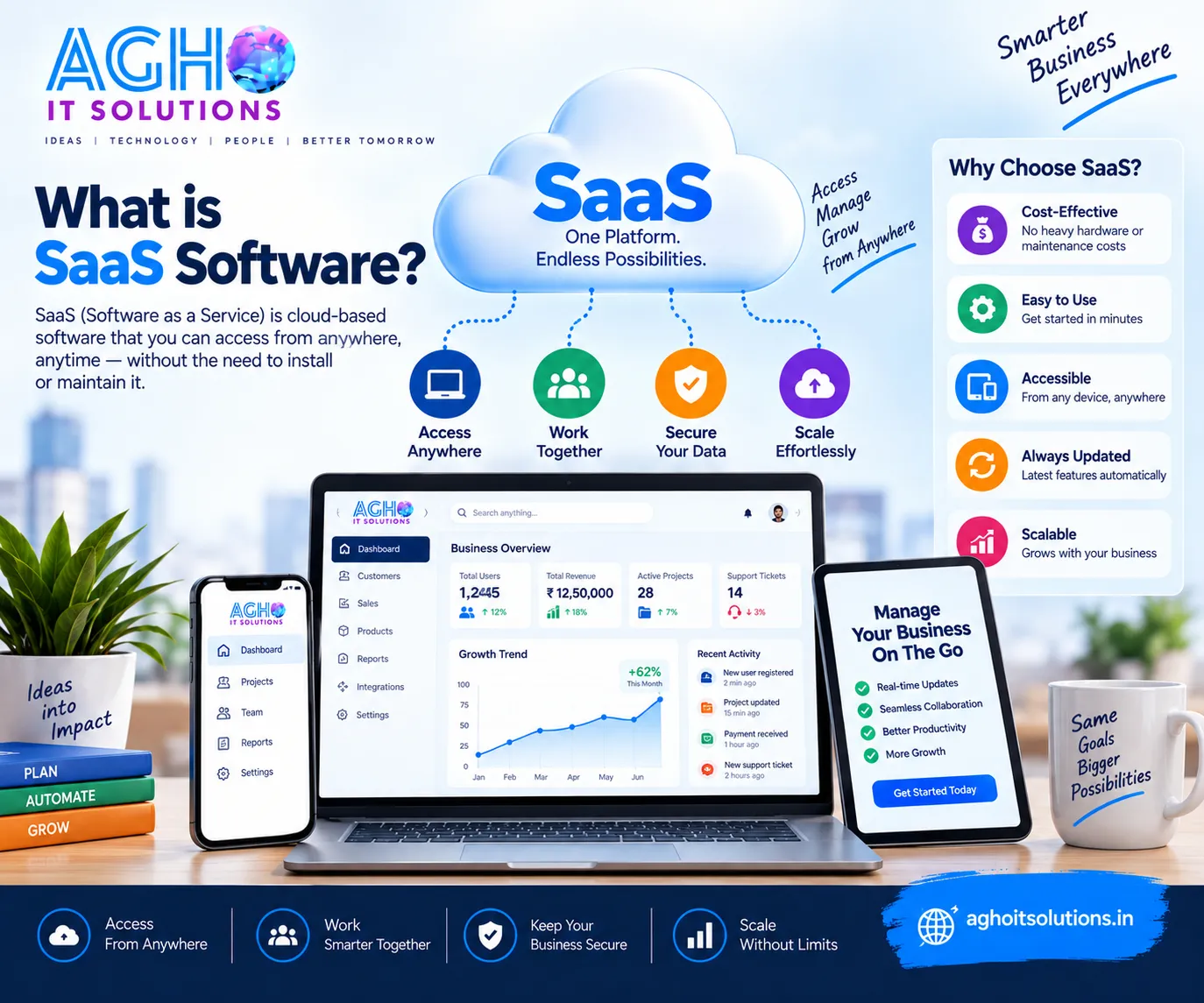
SaaS means the software is hosted on the provider's servers, and you access it over the internet, usually through a browser or an app, instead of installing it on your own computer. You pay a recurring fee, typically monthly or yearly, rather than buying the software once. The provider handles all maintenance, updates, security, and server management on their end.
How SaaS Differs From Traditional Software
Traditional software, sometimes called on premise software, is installed directly on a business's own computers or servers. The business buys a license, often as a one time payment, and is responsible for maintaining and updating it themselves. SaaS flips this model. There is nothing to install, updates happen automatically without any action from the user, and the business pays for ongoing access rather than ownership.
Why SaaS Became the Default Model
SaaS grew popular because it removes a lot of the burden that used to sit with the business buying software. No need for in house IT staff to maintain servers. No large upfront cost that ties up capital. Access from anywhere with an internet connection, which matters for businesses with remote teams or multiple locations. Automatic updates mean the software stays current without any manual effort from the business.
What This Means for a Growing Business
For an Indian business scaling in 2026, SaaS tools make it possible to run accounting, HR, customer management, and marketing operations without hiring a dedicated technical team to manage the underlying software. A small business can access the same quality of tools that larger companies use, paying only for what they need as they grow, rather than a large upfront investment sized for a bigger company.
Where SaaS Has Limits
SaaS is not always the right fit. Businesses with very specific workflows that standard SaaS tools cannot accommodate may find themselves working around the software's limitations rather than the software working for them. Data stored with a third party provider also means the business depends on that provider staying reliable and secure, which is worth considering for any business handling sensitive customer information.
Building a SaaS Product vs Using One
Many businesses also now consider building their own SaaS product to sell to their customers, not just using SaaS tools internally. A business with a service that could be turned into recurring software — a booking system, a management tool specific to their industry — can develop it as a SaaS product with subscription revenue instead of a one time sale. This requires proper SaaS architecture from the start, including multi tenant data handling, subscription billing, and scalable hosting.
Choosing SaaS Tools for Your Business
When evaluating a SaaS tool, check what happens to your data if you cancel the subscription, whether the pricing scales in a way that fits your growth, and whether the provider offers support that matches your business hours and needs. A cheap SaaS tool that lacks support when something breaks can cost more in lost time than a slightly pricier option with reliable help available.