Table of Contents
Introduction
Artificial Intelligence has rapidly transformed the digital landscape. From blog writing and marketing content to software development and automated customer service, AI tools are now deeply embedded in modern workflows. Businesses, media organizations, developers, and content creators are increasingly relying on AI to generate large volumes of content quickly and efficiently.
However, the rapid growth of AI-generated content has also raised serious concerns regarding misinformation, deepfakes, copyright violations, biased outputs, and the potential misuse of artificial intelligence systems. Governments across the world are now stepping forward to introduce regulations that ensure responsible and ethical use of AI technologies.
The Government of India has also taken an important step in this direction by introducing new guidelines related to AI-generated content. These rules aim to regulate how artificial intelligence systems create and distribute content while ensuring transparency, accountability, and public safety.
This article explains the newly introduced AI content regulations, why they were introduced, what they mean for businesses and content creators, and how organizations can adapt to this changing regulatory environment.
Why the Government Introduced AI Content Regulations
Artificial intelligence systems are capable of producing massive amounts of information at unprecedented speed. While this technological advancement brings many advantages, it also introduces several risks.
The Indian government has observed multiple cases where AI-generated content has been used for spreading misleading information, creating manipulated media, impersonating individuals, or generating harmful narratives.
Some of the major concerns include:
- Spread of misinformation and fake news
- Creation of deepfake images and videos
- Manipulated political narratives
- AI-generated scams and fraud
- Copyright violations and content plagiarism
- Bias and discriminatory outputs generated by AI models
Because of these risks, regulators believe that AI-generated content must operate under responsible governance frameworks. The new rules aim to ensure that AI technologies remain beneficial while minimizing harm to society.
Key Highlights of the New AI Content Rules
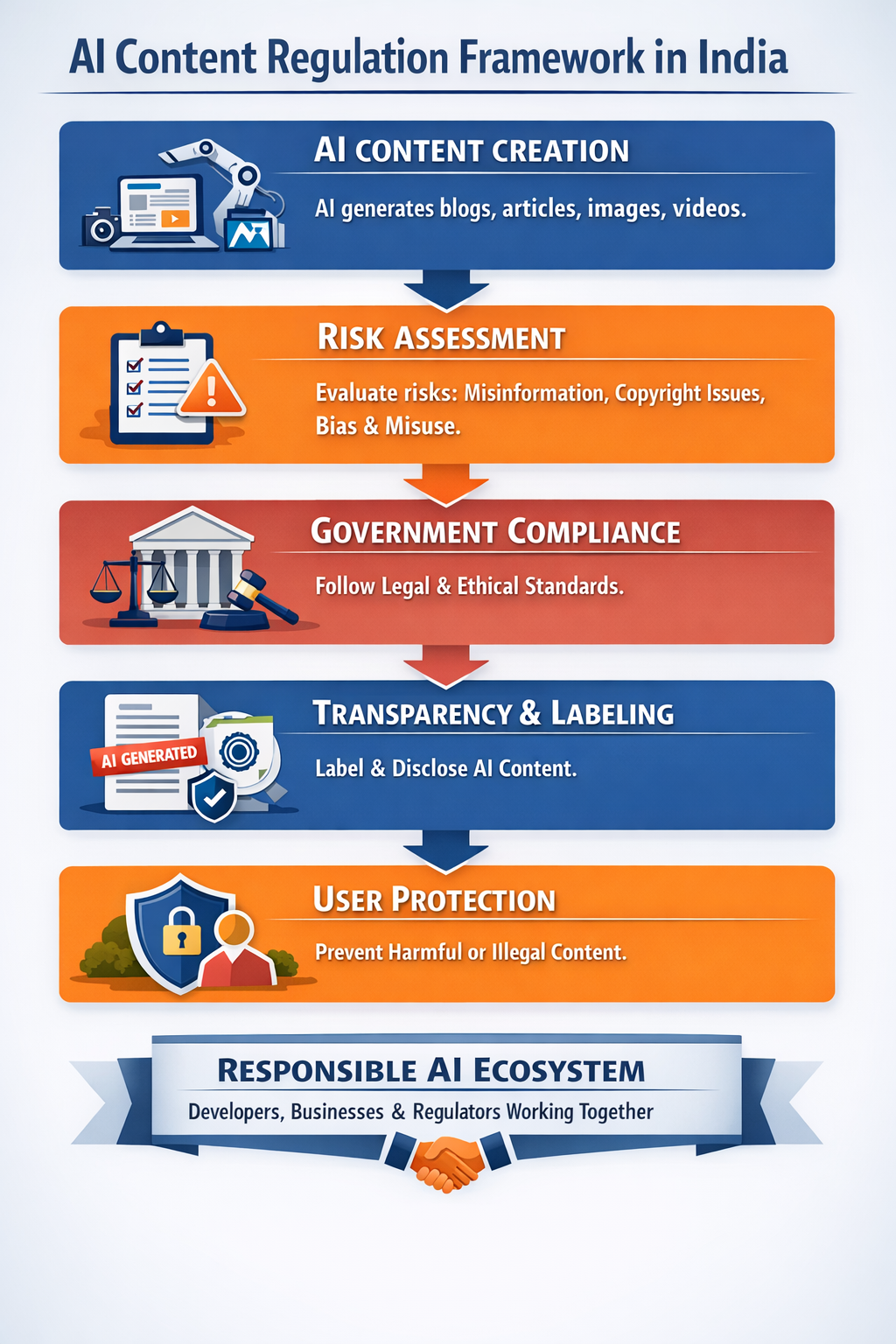
The new guidelines introduced by the central government focus on responsible AI usage, transparency, and accountability.
Important highlights of the new rules include the following:
- Platforms deploying AI models must ensure that generated content does not spread misinformation or illegal material.
- AI-generated content should be clearly labeled or identifiable to users.
- Companies deploying AI systems must implement safeguards against harmful or misleading outputs.
- Developers must ensure that AI tools do not violate Indian laws, including those related to defamation, national security, or public order.
- Platforms may be required to remove harmful AI-generated content when reported.
- Companies must perform risk assessments before launching large-scale AI models in India.
- Artificial intelligence platforms may need government approval before releasing certain experimental AI technologies to the public.
These regulations aim to balance innovation with safety.
Impact on Businesses Using AI Content
Many businesses now rely on AI tools for marketing, customer engagement, automation, and operational efficiency. The introduction of AI regulations will significantly influence how organizations deploy these technologies.
Companies must now ensure that AI-generated content follows legal and ethical guidelines. Businesses that use AI for marketing, blog writing, product descriptions, social media posts, or automated customer interactions must review their content generation processes.
Organizations may need to introduce additional verification layers before publishing AI-generated content. Content moderation, fact-checking, and editorial supervision may become essential parts of AI-driven workflows.
Failure to comply with regulations could lead to legal consequences, reputational damage, or penalties.
Businesses must therefore shift from uncontrolled automation toward responsible AI governance.
Impact on Content Creators and Digital Marketers
Content creators, bloggers, and digital marketers are among the largest users of AI-powered content generation tools. AI writing assistants are widely used to produce articles, social media captions, marketing emails, and promotional materials.
The new rules do not ban AI-generated content. Instead, they encourage responsible use.
Content creators should focus on:
• Verifying facts generated by AI tools
• Avoiding plagiarism or copyright violations
• Ensuring content does not spread misinformation
• Clearly identifying AI-generated content when necessary
• Maintaining editorial oversight over AI outputs
Human supervision remains essential even when AI tools assist in content creation.
AI Transparency and Disclosure Requirements
One of the key elements of the new AI rules is transparency.
Users interacting with AI-generated content should be aware that the content has been produced or assisted by artificial intelligence systems. This transparency builds trust and helps prevent manipulation.
Platforms may need to implement mechanisms such as:
- AI content labeling
- Disclosure statements
- Metadata tags identifying AI-generated material
- Digital watermarking for AI-generated media
These practices help differentiate human-created content from AI-generated outputs.
Transparency will play a critical role in maintaining credibility in the digital ecosystem.
Risks of Unregulated AI Content
Without regulations, artificial intelligence systems could potentially create severe societal risks.
Some of the most dangerous possibilities include:
- Mass generation of fake news articles
- Creation of realistic deepfake videos
- Automated political propaganda
- Identity impersonation using AI-generated voices
- Fraudulent financial schemes
- Automated cyber attacks and scams
These threats demonstrate why governments worldwide are introducing AI governance frameworks.
Responsible AI deployment is now a global priority.
Ethical AI and Responsible Innovation
Artificial intelligence should be developed and deployed in ways that benefit society while minimizing risks. Ethical AI development involves principles such as fairness, accountability, transparency, and safety.
Organizations developing AI technologies must consider:
- Bias mitigation in AI models
- Ethical data usage
- Responsible training datasets
- User safety mechanisms
- Transparency in algorithmic decision making
Responsible AI innovation ensures that technology improves human life rather than creating new forms of harm.
Global Trend Toward AI Regulation
India is not alone in introducing AI governance policies. Many global governments are developing regulatory frameworks for artificial intelligence.
The European Union has introduced the AI Act, which categorizes AI systems based on risk levels. The United States is also working on AI safety guidelines and responsible development standards.
Countries around the world are recognizing that AI regulation is necessary to prevent misuse while still encouraging innovation.
India's approach aligns with global trends in AI governance.
Opportunities for Businesses in Responsible AI
Although regulations may initially appear restrictive, they actually create new opportunities for responsible technology companies.
Businesses that prioritize ethical AI development will gain long-term credibility and trust.
Companies can build competitive advantages by offering:
- Transparent AI solutions
- Secure AI-powered platforms
- Ethical AI consulting services
- AI compliance auditing tools
- AI risk assessment frameworks
Technology companies that align with regulatory frameworks will be better positioned for future growth.
Future of AI Content Creation in India
Artificial intelligence will continue to shape the future of digital content. AI writing tools, generative image models, and automated video production systems are becoming more sophisticated every year.
However, responsible governance will now become an integral part of AI adoption.
Businesses, developers, and content creators must adapt to a new environment where AI innovation and regulatory compliance go hand in hand.
Organizations that combine human expertise with responsible AI usage will lead the next phase of digital transformation.
Conclusion
Artificial intelligence has unlocked unprecedented possibilities for content creation, automation, and digital innovation. However, the same technology also carries risks when used irresponsibly.
The Government of India's new AI content rules represent a significant step toward building a safer digital ecosystem. These regulations emphasize transparency, accountability, and responsible AI usage.
Businesses, developers, and content creators must now adopt ethical AI practices and ensure compliance with regulatory guidelines. Human oversight, content verification, and responsible deployment will become essential components of AI-driven workflows.
Artificial intelligence will continue to evolve, but its success will depend on how responsibly it is used. By following these new regulations, India aims to create a balanced environment where innovation thrives while protecting society from potential technological risks.